-
 Nesting season began a little over six weeks ago, and this week marks NOAA's official Sea Turtle Week. The most recent Southwest Florida numbers available are from, roughly, the end of the first week of June, and they are about the same as this time last year.
 -
 Record amounts of sargassum seaweed are washing onto beaches from Florida to Texas creating foul odors, frustrated beachgoers, and threatening coastal economies across multiple states.
 -
 By mid-April the seaweed, which looks a lot like a watery sweet potato casserole with the brown, crusty topping, had spread across the entire Caribbean Sea, with substantial amounts pushing into the Gulf. Huge amounts washed up along many Caribbean shorelines in what USF researchers call "beaching events" in the bulletins issued at the end of every month.
 -
 This year is predicted to be another big sargassum year, which could potentially be more record-breaking than the 2023 and 2025 seasons. And the problem is only expected to get worse.
 -
 A Florida team has turned a common cause of frustration for many beach-goers into a new food opportunity, after discovering that a common processed food ingredient can be extracted from the sargassum seaweed that at times plagues our beaches.
 -
 Massive piles of sargassum, the size of which have not been seen before, are floating this way, right now, sure to coat the beaches of Florida's East Coast, the Keys, and various Caribbean islands
 -
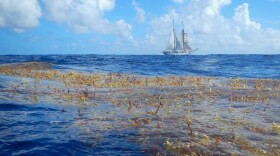 You may know sargassum as the stinky algae that periodically washes ashore, but it's been an important breeding habitat for many marine species in the Atlantic.
 -
 Blooms of yellowish-brown seaweed along the Equator are breaking records and defiling beaches, while a centuries-old patch farther north is disappearing.
 -
 Current estimates suggest that there are around 37.5 million metric tons of sargassum involved in this latest bloom. Despite some of these alarming numbers, current predictions are iffy on how much of an issue sargassum will be for, say, Key Biscayne or Miami Beach.
 -
 A new report says that a record 38 million metric tons of sargassum piled up across the Caribbean and nearby areas in May, with more expected this month. It鈥檚 the biggest amount of algae spotted in the region since scientists began studying the Great Atlantic Sargassum Belt in 2011.
 -
 Scientists at the University of South Florida Optical Oceanography Lab are predicting what could be the state鈥檚 worst seaweed season.
 -
 A USF study found that vertical currents are likely behind the algae blooms that dump sargassum onto Florida beaches each year.

漏 2026 SA国际传谋
Play Live Radio
Next Up:
0:00
0:00
Available On Air Stations


